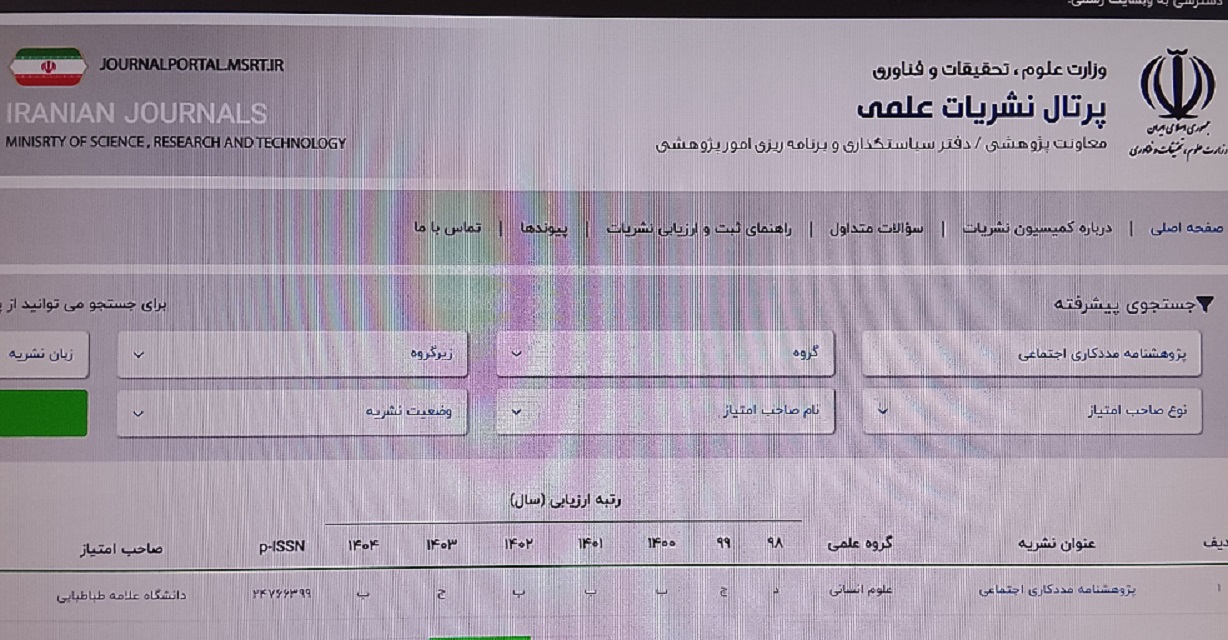
this journal publishes authoritative articles in the following areas: Social work Social Welfare Social health Social Security Social Issues Norms
ًReza Azamzadeh; Soheila Alirezanejad
Abstract
This study aims to understand the role and position of first families in the guardianship of their daughter, the female head of household. To achieve the research objectives, grounded theory was used, and data were collected through semi-structured interviews with 33 female heads of household in Behshahr ...
Read More
This study aims to understand the role and position of first families in the guardianship of their daughter, the female head of household. To achieve the research objectives, grounded theory was used, and data were collected through semi-structured interviews with 33 female heads of household in Behshahr city. Open coding led to the emergence of four main categories: 1- Headship of the household; 2- Expectations of women's role from themselves; 3- Expectations of the female head of household from others; 4- Expectations of the primary family from the female head of household. The findings showed that the support of the primary family has a central influence on the role of female caregivers. After accepting the caregiver role, these women were divided into two groups. Women were placed in two paradigmatic patterns: 1- Self as an agent of change, 2- Self as a need for support. In the first paradigm, women's understanding of femininity is the ability to change in life and achieve goals. However, women in the second paradigm do not have the self-confidence necessary for independence in life, and their understanding of femininity prevents them from trying to change in life without the support of others. The findings show that the primary family influences women's self-perception and reinforces each of the two paradigms mentioned. The first families in this study are divided into two categories: control-oriented and guidance-oriented. The majority of women expected their families to live under the shadow of their father or brother.
this journal publishes authoritative articles in the following areas: Social work Social Welfare Social health Social Security Social Issues Norms
Jafar Hezarjaribi; Narjes Hajmohammadi
Abstract
Successful implementation of the Health Transformation Plan required special attention to the welfare and professional status of nurses. This qualitative study was conducted to analyze the challenges and barriers experienced by nurses in the implementation of this plan from the perspective of social ...
Read More
Successful implementation of the Health Transformation Plan required special attention to the welfare and professional status of nurses. This qualitative study was conducted to analyze the challenges and barriers experienced by nurses in the implementation of this plan from the perspective of social welfare policymaking and human resource governance. Fifteen nurses and nursing managers working in public hospitals in Kerman were selected through purposive sampling, and data were collected via semi-structured interviews. Data analysis was carried out using the Braun and Clarke thematic analysis approach until theoretical saturation was achieved, and credibility was enhanced through repeated data review and alignment of themes with participants’ lived experiences. The findings revealed three main axes: (1) economic welfare and job support policies, including staff shortages, high workload, and income inequality; (2) human capital retention and organizational mental health policies, including job burnout, exposure to trauma, and lack of structured psychological support; and (3) institutional policies and equitable distribution of power, including symbolic discrimination and weak participation in decision-making. The conclusion showed that without simultaneous reform of welfare, institutional, and supportive human resource policies, the Health Transformation Plan faced erosion of human capital and a decline in service quality, and that revising human resource governance policies and establishing structured organizational mental health support were prerequisites for achieving high-quality universal health coverage
this journal publishes authoritative articles in the following areas: Social work Social Welfare Social health Social Security Social Issues Norms
Majid Fouladiyan; Fatemeh Amini; Nafiseh Roshandel
Abstract
Psychiatric and neurological patients, as a marginalized and voiceless group, are often deprived of being seen and heard in society. This article aims to illuminate the hidden dimensions of patients' lives and reflect the realities of human and structural interactions within the hospital environment. ...
Read More
Psychiatric and neurological patients, as a marginalized and voiceless group, are often deprived of being seen and heard in society. This article aims to illuminate the hidden dimensions of patients' lives and reflect the realities of human and structural interactions within the hospital environment. To this end, an ethnographic method and participant observation technique were employed. The research field is a psychiatric and neurological hospital in northeastern Iran. The study population included social workers, nurses, support staff, security guards, and patients. Purposive sampling was conducted among individuals who played a key role in the processes of interaction with patients. The findings consist of six categories: 1- Hospital space and lack of facilities in various wards; 2- Psychiatric and neurological patients receiving support from exhausted caregivers; 3- Stigmatization in interactions with patients; 4- Segregation of patients from staff; 5- Disciplinary care: from order to violence; 6- Challenges of working with psychiatric and neurological patients. The results indicate that many conflicts, acts of violence, and inefficiencies stem from flawed, depleted, and unequal structures—structures that not only fail to provide effective support for patients but also push the healthcare staff toward the reproduction of violence, indifference, and discrimination.
this journal publishes authoritative articles in the following areas: Social work Social Welfare Social health Social Security Social Issues Norms
Azam Ahangar Solehboni
Abstract
The Iran-Iraq war left deep scars on countless families, particularly on the daughters who lost their fathers. Over 87,000 girls grew up without a father’s presence, navigating a world forever altered by war. Beyond the political and infrastructural consequences, the war shaped their personal and ...
Read More
The Iran-Iraq war left deep scars on countless families, particularly on the daughters who lost their fathers. Over 87,000 girls grew up without a father’s presence, navigating a world forever altered by war. Beyond the political and infrastructural consequences, the war shaped their personal and social lives in profound ways. These daughters carried silent struggles, their voices often unheard. Understanding their lived experiences is not just about acknowledging the past—it’s about learning from their resilience, recognizing their challenges, and ensuring that society does not overlook the unique burdens they have carried.This study sought to give voice to these daughters by exploring their lived experiences through a qualitative approach. In-depth interviews with 15 women provided a deep, personal insight into their journeys. Through their narratives, common themes emerged—stories of loss, adaptation, and perseverance. Their words painted a picture of childhoods marked by both resilience and hardship, shaped by the absence of a father and the structures that sought to fill that void.Findings reveal that, despite government support and the efforts of the Martyrs Foundation, these daughters faced struggles beyond institutional interventions. Their challenges were rooted in societal norms, traditions, and legal constraints. Their experiences spanned grief in early childhood, the presence of stepfathers, unique educational and social paths, contradictions in societal expectations, marriage struggles, custodial disputes, and ongoing social stigmas. Their realities often clashed with how society perceived them, leading to misunderstandings and emotional burdens that still shape their daily lives today.
this journal publishes authoritative articles in the following areas: Social work Social Welfare Social health Social Security Social Issues Norms
Mohsen Noghani Dokht Bahmani; Seyed Mahdi Panjtani
Abstract
The chronic economic crisis in recent years, by weakening purchasing power and increasing livelihood insecurity, has forced lower social groups to redefine their means of securing daily life. Among these, daily-wage construction workers, due to job instability, low wages, and weak institutional support, ...
Read More
The chronic economic crisis in recent years, by weakening purchasing power and increasing livelihood insecurity, has forced lower social groups to redefine their means of securing daily life. Among these, daily-wage construction workers, due to job instability, low wages, and weak institutional support, are more exposed to the consequences of this crisis than other groups. The aim of this study is to identify and analyze the patterns of economic action adopted by construction workers in response to the ongoing economic crisis. This research employs a qualitative approach using grounded theory methodology. The field of study consisted of daily-wage construction workers active in the city of Mashhad in 2021 (Iranian year 1400). Through purposive sampling based on theoretical saturation, 14 workers were selected and studied using in-depth narrative interviews. The findings indicate that in the face of the economic crisis, construction workers employ strategies such as forcibly reducing their level of needs, shifting consumption patterns toward essentials, utilizing limited savings, and selling durable assets. Although these actions enable survival in the short term, in the long run they lead to the erosion of economic security, the weakening of support networks, a decline in quality of life, reduced satisfaction, and an increased sense of frustration. The persistence of this situation lays the groundwork for the reproduction and deepening of poverty among daily-wage construction workers.
this journal publishes authoritative articles in the following areas: Social work Social Welfare Social health Social Security Social Issues Norms
Nastaran Adnani; Elham Mohammadi
Abstract
This research conducted with the aim of configuring the role of the family in the return of the person who was in the prison return to the society. Since reintegration into society is a process that begins before the person is released from prison. After releasing from prison, they face many obstacles ...
Read More
This research conducted with the aim of configuring the role of the family in the return of the person who was in the prison return to the society. Since reintegration into society is a process that begins before the person is released from prison. After releasing from prison, they face many obstacles and problems. As if he failed, he may return to prison once again. The main question of this research is how families took part and prevent him/her from going back to prison. In this qualitative research, data collection was done through semi-structured interviews with 15 former prisoners and 13 effective members of the prisoner's family. Written interviews were coded and interpreted using thematic analysis method. In this research, 4 themes and 9 concepts were extracted. Overcoming the transition crisis, accepting, and identifying a person with a new identity, accelerating adaptation to the world outside the prison to regain social status, restoring self-esteem and playing a role outside the system are the themes that were identified under family driving factors. The reason for going to prison, or in other words, the crime for which a person has been convicted, has an effective role in his/her incarceration experience and reintegration process back to society. Although all people who get in prison are guilty as a legal perspective; people include families and relatives confront released persons from prison, based on their own prejudice of their crimes and faults.