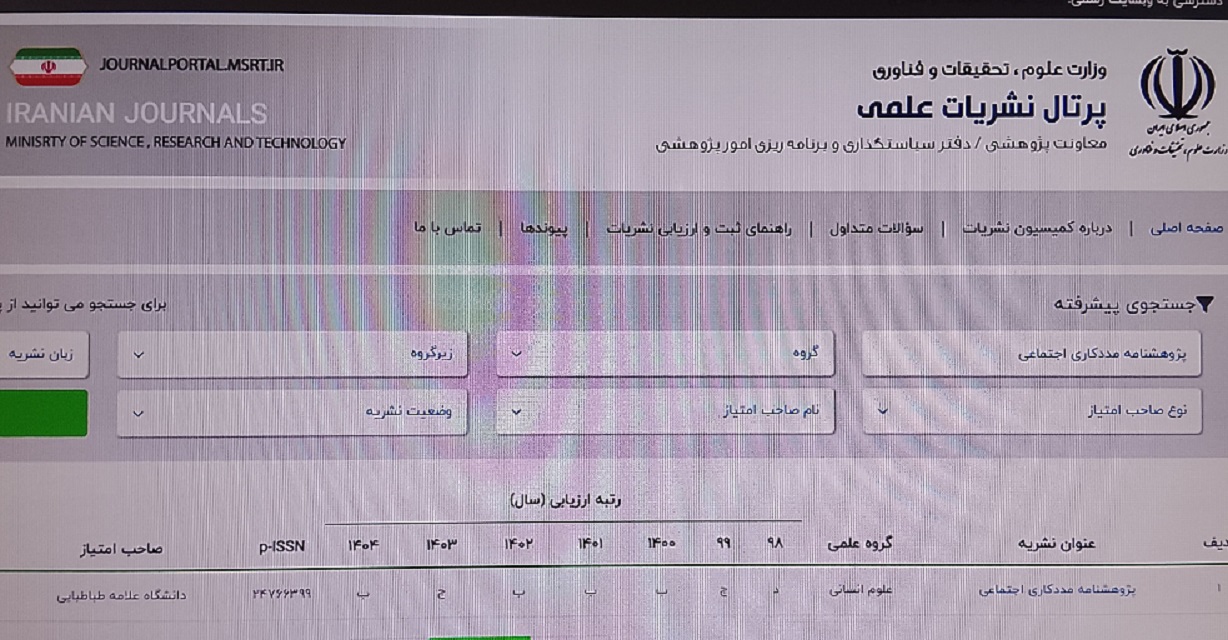
Number of Issues

46

Article View

485950

PDF Download

501,005

View Per Article

1669.93

PDF Download Per Article

1721.67

Number of Submissions

907

Rejected Submissions

455

Reject Rate

50

Accepted Submissions

274

Acceptance Rate

30

Time to Accept (Days)

398

Number of Indexing Databases

13

Number of Reviewers

230

Research Journal on Social Work (RJSW) is an open-access, double-blind, peer-reviewed journal published by Allameh Tabataba’i University, the leading university in Humanities and Social Sciences in Iran. RJSW has been established to provide an intellectual platform for national and international researchers working on issues related to social work. The Journal was founded as a response to quick advancements in social work and was dedicated to the publication of highest-quality research studies that report findings on issues of great concern to the profession of social work.  

To allow for easy and worldwide access to the most updated research findings, the journal is set to be an open-access journal. 

The journal charges two million Rials to compensate a part of the arbitration fee, and if the article is accepted, additonally four million Rials will be charged from the authors for a part of the costs of processing the articles, the rest of the costs will be financially supported by Allameh Tabatabai University.

Non-Iranian authors are free of mentioned charges.

The journal is published in both a print version and an online version.

this journal publishes authoritative articles in the following areas: Social work Social Welfare Social health Social Security Social Issues Norms

Explaining the components of social resilience within the framework of urban resilience of Tehran metropolis

Pages 1-49

https://doi.org/10.22054/rjsw.2026.90436.859

Mohammad Sheikhi, Mahmoud Jomepour, asmail piri

Abstract Social resilience refers to the ability of societies to cope, adapt, and recover effectively from crises, risks, and environmental, economic, and social changes. This concept emphasizes the capacity of individuals, groups, and social institutions to maintain cohesion, participation, mutual trust, and continuity of basic societal functions in crisis situations. The importance of social resilience in metropolises has received more attention than ever before due to increasing social complexity, population growth, and the diversity of risks. Promoting social resilience can provide the basis for reducing vulnerability, strengthening social capital, increasing citizens' adaptive capacity, and improving crisis management capacity, and play an important role in achieving sustainable urban development. The purpose of the present study is to extract the components of social resilience in the Tehran metropolis. The research method of this study is qualitative, and semi-structured interviews were conducted with 33 experts to extract the components of social resilience. After collecting the data from interviews with social dimension experts, they were extracted and categorized into 5 components: identity and sense of belonging (in the form of community satisfaction and sense of belonging indicators), social justice (in the form of access to services, inclusiveness, and social security indicators), quality of life (in the form of security, health, peace, and access to public spaces indicators), social capital (in the form of social cohesion, participation, and cooperation indicators, education, awareness, and trust indicators), and cultural capital (with indicators of ethnicities and religions, citizenship rights, and customs).

this journal publishes authoritative articles in the following areas: Social work Social Welfare Social health Social Security Social Issues Norms

The Individual and Social Consequences of Early Marriage in Women’s Lives

Pages 51-91

https://doi.org/10.22054/rjsw.2026.91471.870

mona mohammadi, nader hajloo, niloofar mikaeili, akbar atadokht

Abstract Early marriage, as a significant social and familial issue, has extensive consequences on the psychological, cognitive, and social aspects of women's lives and can meaningfully influence their individual and social development trajectories. The present study aimed to explore the lifeworld of women with early marriage experiences and to identify the individual, familial, and socio-economic–cultural consequences of this phenomenon. This study employed a qualitative approach using thematic analysis. Data were collected through semi-structured, in-depth interviews with 27 married women who had experienced marriage before the age of 18. Participants were selected through purposive sampling with maximum variation to capture a wide range of experiences. The interviews were transcribed verbatim, and data were analyzed through iterative coding, constant comparison, and abstraction processes. The findings indicated that early marriage has profound and intertwined consequences at the individual level, including psychological harms, identity formation disturbances, and physical health issues; at the familial level, including reduced marital satisfaction, impaired parenting, and family tensions; and at the socio-economic–cultural level, including school dropout, decreased social participation, perpetuation of poverty, and reproduction of traditional gender norms. Overall, the results demonstrate that the consequences of early marriage are multi-level and intergenerational, highlighting the necessity of designing multidimensional psychological, educational, and policy interventions to prevent and mitigate its effects.

this journal publishes authoritative articles in the following areas: Social work Social Welfare Social health Social Security Social Issues Norms

Case Report on Social Work Interventions with a Complicated Case in a Hospital Setting

Pages 93-137

https://doi.org/10.22054/rjsw.2026.81595.771

Hamideh Adelyan, Negar Seraj

Abstract This article reports on the intervention of a social worker on a 21-year-old single girl (nicknamed Yalda) who referred herself to a hospital in Tehran with pregnancy symptoms. The present study was conducted with a qualitative approach and a case report method, and the data were examined through thematic analysis. The social worker's interventions were carried out with two main perspectives: crisis intervention and motivational interviewing. Yalda had experienced emotional turmoil, suicidal thoughts, repressed anger, and risky behaviors following an out-of-wedlock pregnancy, contracting the sexually transmitted disease HPV, losing her job, and emotional breakdown. Pregnancy was considered a serious threat to her social status. During the intervention process, the social worker, by establishing a professional and supportive relationship, paved the way for a change in the client's attitude; so that Yalda decided to start treatment for her illness after giving birth and to consciously manage her sexual and emotional relationships. Also, with the focus on returning to normal functioning before the crisis, family empowerment and support were emphasized. The family gradually accepted the pregnancy and became a source of support and security for Yalda. The main themes in this study are: 1) Crisis intervention 2) Motivational interviewing as an empowerment approach to behavior change 3) Systemic and multidisciplinary intervention in the hospital context 4) Promoting resilience and psychosocial empowerment 5) Documentation, evaluation, and professional review of interventions.

this journal publishes authoritative articles in the following areas: Social work Social Welfare Social health Social Security Social Issues Norms

Factors affecting relapse in recovered individuals in substance dependence disorder

Pages 139-171

https://doi.org/10.22054/rjsw.2026.83583.789

Meysam Ostovarravari, Abrahim saleheabadi, Alireza Ghorbani

Abstract Objective: The present study aimed to investigate the factors affecting relapse among recovered substance users in addiction treatment camps in Kerman, Iran. Methods: This descriptive-correlational study employed a cross-sectional design. The statistical population comprised all individuals referring to addiction treatment camps in Kerman. Using Morgan’s table, a sample of 355 participants was selected through two-stage cluster and random sampling. Data were collected using three standardized instruments: The Social Support Questionnaire (Fleming et al., 1982), the Relapse Prediction Scale (Wright, 1993), and the Family Functioning Questionnaire (Epstein et al., 1983). Data were analyzed using Pearson’s correlation coefficient and regression analysis. Results: Findings revealed a significant negative and indirect relationship between family functioning, social support, and relapse to substance use. Significant relationships were also found between perceived social support from family, perceived support from friends, general social support, and relapse among recovered individuals in addiction treatment camps in Kerman. Furthermore, residence status, educational level, and income were significantly associated with relapse. Perceived social support from family, perceived support from friends, social support, general support, individual factors, and economic factors emerged as significant predictors of substance use relapse. Conclusion: Special attention should be paid to the role of family and social support in preventing relapse among individuals recovering from substance use disorders.

this journal publishes authoritative articles in the following areas: Social work Social Welfare Social health Social Security Social Issues Norms

Components of the Professional Social Work Relationship from the Viewpoint of Clients of Non-Governmental Social Service Organizations

Pages 173-223

https://doi.org/10.22054/rjsw.2026.83822.793

Toktam AzarAfra, Mansour Fathi

Abstract An effective professional relationship is one of the most important skills that social workers can utilize to empower and improve the quality of life of their clients. This qualitative study aimed to understand the characteristics of an effective professional relationship from the perspective of clients of non-governmental organizations. Participants were women over 20years old who had been in contact with social workers for at least six months. Semi-structured interviews were conducted and analyzed using thematic analysis. Ultimately, participants identified three main themes that influenced the professional relationship from their perspective: facilitators of the professional relationship, including kindness, punctuality, emotional control, non-judgment, active listening, understanding and follow-up, encouragement, respectful behavior, etc.; barriers and challenges to the relationship, including bad manners, threats of abandonment, false promises, breach of confidentiality, ignoring the client's speech, and disregarding the termination of the relationship, etc.; and structural conditions, including organizational resources, the power of managers, and the constant change of social workers and human resources conditions.The findings of this research will, first and foremost, help all social workers across their various fields of activity to understand clients' expectations of the professional relationship and grasp their needs in a more tangible manner. Furthermore, in subsequent steps, this research can be utilized in social worker education, professional supervision, and future research.

this journal publishes authoritative articles in the following areas: Social work Social Welfare Social health Social Security Social Issues Norms

Typology of child marriage in girls with early marriage experience, Case study, Mashhad city

Pages 225-270

https://doi.org/10.22054/rjsw.2026.89748.855

tahereh rahimpoorazghady

Abstract The present study aimed to explore the contexts and experiences of child-married girls from a psychological, social, and structural perspective, using a qualitative method and content analysis. The participants included 30 girls who had experienced marriage before the age of 18 and had gone to court to obtain a court order.These individuals were selected through purposive and snowball sampling. Data were collected through semi-structured interviews and analyzed using a thematic analysis approach. The findings showed that early marriage is shaped by factors such as economic poverty, family traditionalism, structural pressures, weak emotional relationships, and immature emotional or cognitive motivations.Also, in this study, five types of child marriage were identified: family-avoiding, traditional and passive, emotional and sentimental, purposeful but immature, and structural-coercive. These types reflect the complexity and diversity of the social and cultural contexts affecting the phenomenon of child marriage.The findings emphasize the need for typology-based policymaking, strengthening girls' agency, and reforming cultural perspectives on marriage and girls' development.

this journal publishes authoritative articles in the following areas: Social work Social Welfare Social health Social Security Social Issues Norms

challenges and obstacles of empowerment projects of women heads of households covered by the welfare organization of Sanandaj city

Articles in Press, Corrected Proof, Available Online from 16 February 2026

https://doi.org/10.22054/rjsw.2026.78313.745

Mansour Fathi, بابامحمدی babamohammadi, Hamideh Addelyan Rasi

Abstract This study was conducted with the aim of identifying the challenges and obstacles to the empowerment projects of women heads of households under the coverage of the Welfare Organization of Sanandaj. This study was conducted qualitatively and using the purposive sampling method. The participants were 10 experts who cooperate with the Welfare Organization, as well as 15 women heads of households who are covered by the Welfare Organization and have used empowerment programs and services. In order to collect information, semi-structured interviews were used, and thematic analysis was used to analyze the information. Five main themes and eleven sub-themes were obtained from the information analysis. The main themes include: communication gap, process challenges, economic barriers, environmental disabling factors, and structural factors. The four themes were raised jointly by both experts and women heads of households, and the last theme, titled structural factors, was raised only by experts. The results of this study showed that despite the efforts of the Welfare Organization to provide empowerment plans and programs for female heads of households, these plans face various challenges and problems; weakness in performing professional work, lack of facilitation of employment conditions, inefficiency of education, lack of financial support for plans, cultural and social factors, administrative bureaucracy, and weak inter-organizational cooperation are among the obstacles and challenges of the programs.

this journal publishes authoritative articles in the following areas: Social work Social Welfare Social health Social Security Social Issues Norms

Lived Experience of Retirement: Fears, Hopes, and Challenges

Articles in Press, Corrected Proof, Available Online from 28 November 2026

https://doi.org/10.22054/rjsw.2026.91305.867

Motahare gholami nia, Ali. akbar Taj Mazinani

Abstract This study aimed to explore the lived experience of retirees of the interaction between the insurance system and the psychosocial constructs of "hope" and "security and well-being". The present study was conducted with a qualitative approach method. The participants were 20 retirees covered by pension funds who were selected through purposive sampling. The data were collected through semi-structured interviews based on the Brown and Clark approach. The findings were organized into five main themes: 1. Institutional uncertainty: insurance as a field of doubt, 2. Conditional hope: living between dependence and self-reliance, 3. Satisfactory quality of life: adjusting expectations in the shadow of deprivation, 4. Retirees on the path of cultural identity and inner peace and hope, from acceptance to balance, 5. The analysis showed that the insurance experience is not a mere support, but a factor in shaping a fragile and context-dependent hope that defines quality of life not in terms of objective well-being, but rather in terms of psychological adjustment and mental adjustment. The findings revealed that retirees struggle not merely with financial insufficiency, but with a deeper deficit of institutionalized hope. Inefficiency of the insurance system, erosion of institutional trust, social isolation, and identity crisis collectively undermine subjective quality of life, reducing it to a state of resigned contentment. This study argues for a paradigm shift from financial welfare policy toward psychosocial welfare policy — an approach in which institutions guarantee not only subsistence, but also meaning, identity, and dignity for retirees.

this journal publishes authoritative articles in the following areas: Social work Social Welfare Social health Social Security Social Issues Norms

Issues and Challenges Facing Women Whose Husbands Alcohol Use Disorder: An Analysis of Lived Experiences

Articles in Press, Corrected Proof, Available Online from 28 November 2026

https://doi.org/10.22054/rjsw.2026.92460.880

Mehdi Ghaderi, Hossein Mohammadzadeh, Yeganeh Soleiman Beigi

Abstract As a socio-psychological issue, alcoholism undermines the foundations of collective life and social bonds by disrupting emotional connections and impairing family functions. This study aimed to conduct an in-depth exploration of the lived experiences of women whose husbands suffer from alcoholism and the consequences of this phenomenon on the family lifeworld in Sanandaj. The research employed a qualitative method based on an "interpretive phenomenology" approach. Participants were selected from eligible women through "purposive sampling", and data were collected using in-depth, semi-structured interviews with 10 participants until theoretical saturation was achieved. "Thematic analysis" was employed to analyze and interpret the data. The findings were classified into six main themes: "The Intertwinement of Emotional-Psychological Suffering", "The Rupture of Family Bonds'', "The Erosion of Social Ties", "Financial Bankruptcy and the Collapse of the Supportive Role", "Inner Tension and Entrapment in the Vicious Cycle of Addiction", and "The Reproduction of Harm and the Intergenerational Perpetuation of Deprivation". The analysis of these themes revealed the "dialectic of the gradual collapse of the family lifeworld" as the core theme, indicating a gradual, self-reinforcing, multi-layered, and intergenerational logic in the process of alcoholism's domination over the family. The results showed that women became entrapped in cycles of harm; A situation where psychological suffering, emotional ruptures, economic pressures, social isolation, and intergenerational deprivations reciprocally intensified each other in a dialectical connection, making escape impossible. The findings underscore the necessity of rethinking support policies and designing contextualized, multi-level interventions to protect family foundation in the face of social harms.

this journal publishes authoritative articles in the following areas: Social work Social Welfare Social health Social Security Social Issues Norms

The Role of Self-Worth and Psychological Flexibility in Predicting Self-Criticism with the Mediation of Self-Compassion in Women Affected by Domestic Violence

Articles in Press, Corrected Proof, Available Online from 28 November 2026

https://doi.org/10.22054/rjsw.2026.94493.892

shahriar Dargahi, Kosar Seyyed Nezhad, araz boukani

Abstract The aim of the present study was to investigate the role of self-worth and psychological flexibility in predicting self-criticism with the mediation of self-compassion in women affected by domestic violence. The research design was descriptive-correlational, conducted using path analysis. The statistical population consisted of women affected by domestic violence in Tehran during 2024–2025. The sample size was 200 participants, selected through convenience sampling, who completed the Self-Criticism Questionnaire (Thompson & Zuroff, 2004), Self-Worth Questionnaire (Crocker et al., 2003), Psychological Flexibility Questionnaire (Ben-Itzhak et al., 2014), and Self-Compassion Questionnaire (Neff, 2003). The results showed that self-worth and psychological flexibility had significant positive direct effects on self-compassion. Furthermore, the bootstrap test results indicated that self-compassion played a significant mediating role in the relationship between self-worth and psychological flexibility with self-criticism. According to the final model, self-compassion plays a key mediating role, such that self-worth only exerts an indirect effect on self-criticism through self-compassion, while psychological flexibility not only has a direct reducing effect but also decreases self-criticism through this same pathway. Therefore, therapeutic approaches aimed at simultaneously strengthening psychological flexibility and self-compassion can be an effective strategy in improving mental health and reducing self-criticism among women victims of domestic violence.

Keywords Cloud